Scrum vs Kanban: A Comparison of Agile Methodologies

Companies must be agile. Companies must deliver digital services quickly; they must align with customers’ every-changing needs. Lean startups are all the rage in the age of VUCA. Pivoting in response to consumer trends can no longer wait for monolithic and bureaucratic change procedures. Practitioners in the tech field have prioritized two approaches, Scrum and Kanban, in pursuit of this agility.
Let’s look at the main differences between Scrum and Kanban. Note that they are not in opposition—it’s not one or the other. In fact, you may get the most benefit when using them in tandem.
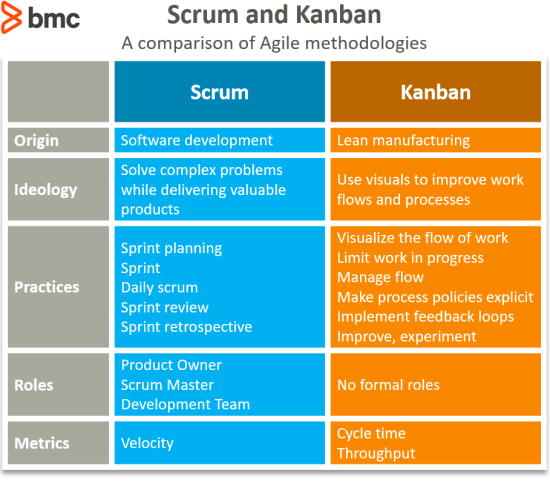
The way Scrum and Kanban originated highlights their differences.
Scrum originated with a January 1986 HBR paper, The New New Product Development Game, written by Hirotaka Takeuchi and Ikujiro Nonaka. The main premise was to move away from a sequential approach to new product development. Instead, developers should embrace a holistic, fast, flexible process. (Takeuchi and Nonaka borrowed from the game of rugby, hence the name Scrum.)
Ken Schwaber and Jeff Sutherland embraced these ideas, presenting Scrum and its applicability to software development at the 1995 Object-Oriented Programming, Systems, Languages & Applications (OOPSLA) conference. In 2001, Schwaber and Sutherland participated in the famous ski resort meeting where the Agile Manifesto was crafted. The two later authored the Scrum Guide, in 2010, which is recognized today as the official Scrum Body of Knowledge.
Kanban originates decades earlier, when Japanese shop owners used sign boards in crowded streets to advertise their wares and differentiate them from competitors. The name Kanban comes from two Japanese names, Kan meaning ‘sign’ and Ban meaning a ‘board’.
In 1956, a young Toyota industrial engineer Taiichi Ohno created a system that used paper cards for signaling and tracking demand in his factory, naming the new system Kanban. Benefits including reduced stockpiles, improved throughput, and provided high visibility into the process propelled this approach to success. The system was incorporated into the entire organization in 1963 and became part of the Toyota Production System.
In 2004, David J. Anderson was the first to apply Kanban to IT, software development, and knowledge work.
People use the Scrum framework to address complex adaptive problems, while productively and creatively delivering products of the highest possible value. Scrum is founded on empirical process control theory, which asserts that knowledge comes from experience and making decisions based on what is known. Three pillars uphold this approach:
Kanban is a way to improve flow and provoke system improvement through visualization and controlling work in progress. It has four foundational principles:
Scrum denotes five time-based events for managing product delivery iteratively and incrementally, while maximizing opportunities for feedback. These are:
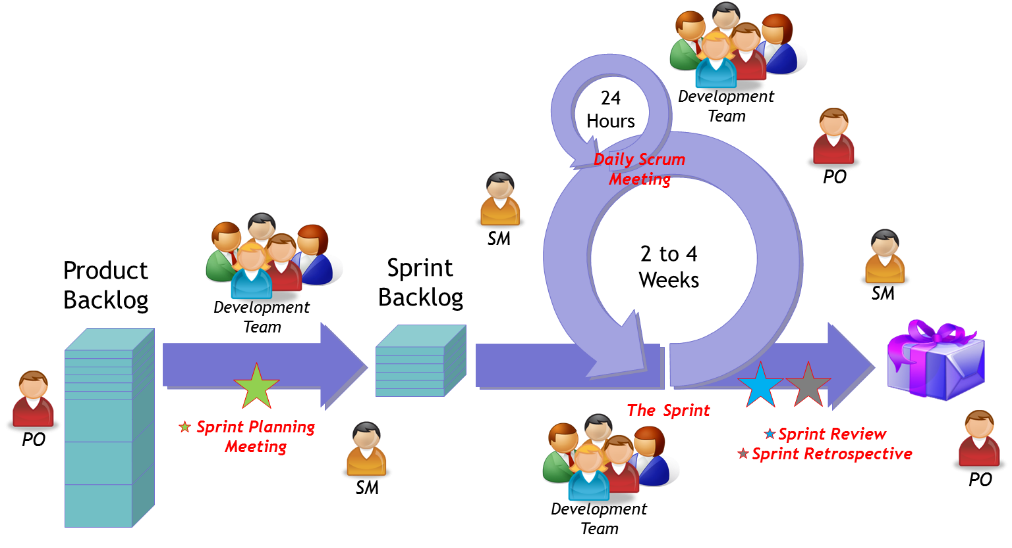 Scrum framework (Source)
Kanban has six core practices:
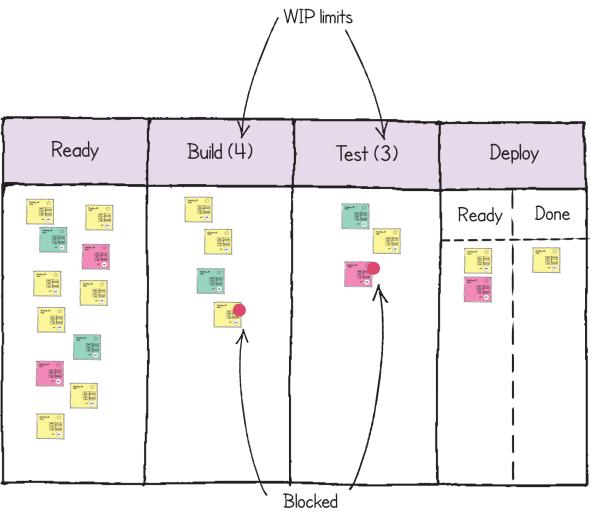 Kanban Board (Source)
Scrum defines three main roles:
Kanban has no set roles. However, David Anderson advocates for two roles:
In Scrum, the main production metric is velocity. This describes the rate of progress of what the team is delivering, based on the estimation carried out during sprint planning. The scrum team uses velocity as an indicator of how much they are delivering the items in the product backlog at each sprint, based on the effort required.
Kanban uses two main metrics:
Scrum and Kanban can be used together, both in development environments and IT service management. In fact, the Scrumban framework has emerged. Scrumban leverages both frameworks to better embrace agility and to improve what is lacking in each. Using both frameworks provides many benefits, particularly from a people perspective: fostering collaboration and improvement through feedback and focusing attention on delivering business value.
To learn more about Agile and software development, check out these BMC Blogs: