Enterprise networking explained: Types, concepts and trends

Think of the Enterprise Network as the internet, except that it’s local to your organization.
An enterprise network helps employees and machines communicate, share files, access systems, and analyze the performance of an IT environment that drives business operations. Enterprise networks are configured to:
In this article, we will discuss the enterprise network, how it helps the business, and industry-proven best practices to run secure, high performance, and highly dependable enterprise networking systems.
The term ‘enterprise network’ refers to the physical, virtual, or logical connectivity infrastructure that enables systems and apps to:
The enterprise network effectively comprises the infrastructure, hardware and software systems, and the communication protocols used to deliver end-to-end services. The network (or its subset) may be architected, designed, deployed, optimized, and configured to perform a unique set of business and technical objectives.
To establish an enterprise network at geographically disparate locations, use Virtual Private Networks (VPNs) to connect these regions.
(Understand IT infrastructure and cloud infrastructure.)
Some of the common types of enterprise networks include:
A LAN is a computer network that interconnects systems within a small building or room. Typically used for personal, non-commercial use cases, LANs can also be used as small-scale prototyping or testbed networks.
You can also establish LANs logically and virtually within a larger network. For example, each department within the enterprise network can operate a small LAN where multiple computers are connected to the same switch but decoupled from other departmental LANs.
Think of a LAN that spans across buildings and disparate geographic locations—even globally.
WAN connectivity differs from LANs in terms of the protocols and components across the layers of the OSI model used to transmit data. While LAN technologies are used to transmit data at higher rates within close proximity, WANs are set up for communication that is:
WANs can be deployed as a private or public network and are usually set up by the internet service providers (ISPs).
You can also have a software-defined WAN, or SD-WAN. This is a virtual WAN architecture controlled by software technologies that create an abstraction of the virtualized WAN from the underlying infrastructure components. This technology enables secure WAN operations while decoupling the performance from the underlying components.
An SD-WAN offers more flexible and dependable connectivity services that can be controlled at the application level, without sacrificing security and quality of service (QoS).
(Learn more about software-defined networking.)
Most enterprise IT services are delivered from data centers and cloud networks. The IT environment may be a hybrid mix of on-premise servers and off-site cloud networks. The cloud stack may consist of multiple cloud computing models—private, public, and hybrid cloud.
Additionally, you likely employ multi-cloud services to deliver various application components and services as an optimal tradeoff between cost, performance, and security offered by different cloud models.
The infrastructure components and software technologies enable the connectivity between data center hardware, applications. and services running across these various IT environments. The cloud resources and the services running on the hardware are accessed and controlled over the internet, usually through private and secure network channels (unless used for public-facing applications).
Conceptually, cloud networks can be seen as a WAN (often an SD-WAN) that may comprise multiple subset of networks shared or distributed privately among customers of cloud computing services.
The networking architecture of your enterprise is the digital foundation for your organization. It enables the agility you need and provides security that evolves to stay ahead of changing threats. Functionally, it provides the connectivity between people, devices, applications, and data to optimize operations and empower innovation.
The right networking architecture supports long-term growth and helps your organization thrive with these core benefits:
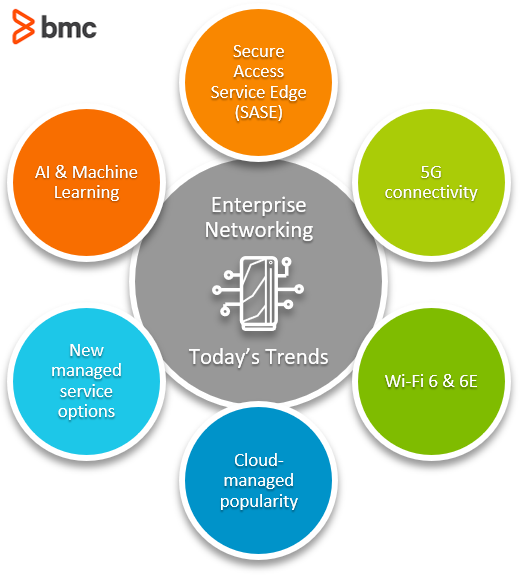
Already embarked on your enterprise networking strategy? It can be interesting to follow some of the latest trends in the enterprise networking domain.
Today’s technology advancements and improvements are generally centered around service dependability, security, and readiness to integrate new technology standards and systems.
Some new innovations and trends include:
(See how ML supports data center network security.)