Bring Your Own Device (BYOD): Best Practices for the Workplace

Not so long ago, the Bring Your Own Device (BYOD) movement was largely contested across enterprise organizations. Proponents of the BYOD trend focused the debate on the productivity benefits of BYOD. Opponents uncompromisingly considered it as a liability.
Both sides remained adamant until progressive organizations riding the wave of enterprise mobility took action, unleashing the value that BYOD has to offer. These actions involved strategic best practices and layers of risk mitigation activities that ultimately enable BYOD devices—and their users—to:
So, in this article, let’s look at why more and more people want BYOD. Then, we’ll consider the hard question: is BYOD really worth the security headache?
BYOD is a set of policies that allow employees to bring in and use their own personal devices. These devices can include laptops, smartphones, tablets, whatever is needed to complete the tasks they face.
The goal behind BYOD is straightforward: because workers use their personal devices to access company data and systems, employees should be more productive in the long run.
Today, of course, many companies are creating distributed workplaces, powered in part by more relaxed approaches to BYOD. When the pandemic hit, an employee might not have been able to easily work from their phone or tablet. Now a variety of software solutions support employees in the brave new world of remote work, making BYOD important in a way it had never been before.
BYOD practices thrive in Agile and DevOps-driven environments. Users should take advantage of well-integrated cloud solutions to facilitate collaboration, communication, and information access across otherwise siloed organizational departments.
Although many find the idea of using a personal device quite attractive, BYOD initiatives need to be carefully considered. Employee satisfaction and overall enterprise agility needs to be carefully weighed against the risks and the necessary Mobile Device Management (MDM) that needs to happen before employees can download potentially sensitive data to their devices.
Other challenges of using personal devices for work include…
BYOD falls somewhere between the business and IT functions, resulting in service desks that often fail to support the needs of the agile and mobile workforce. That’s because service desks were mostly built to service on-premises employees using employer-provided equipment.
This stark divide leads to many data and security concerns for businesses, particularly when they cannot meet the demand of their employees.
Repeated requests, unfavorable governance, and slow request approval processes encourage the workforce to take matters into their own hands. Employees may adopt shadow IT—the grey area where users download or use software and apps that your organization hasn’t approved. The risk here? These shadow IT practices bypass your security mechanisms.
The elephant in the room is the lost/stolen problem. Although it's nice for your employees to complete work-related tasks with their own mobile devices, there is a serious risk of your employees losing the device and placing company data into the hands of possibly anyone, especially with cloud-native apps that make syncing and sharing data as easy as pressing a button.
For industries that need a high level of security on every single device, think about what you gain and what you have to trade. Are the benefits of BYOD solutions enough to warrant storing data on a device which might be secure? That's a question which a lot companies answer differently.
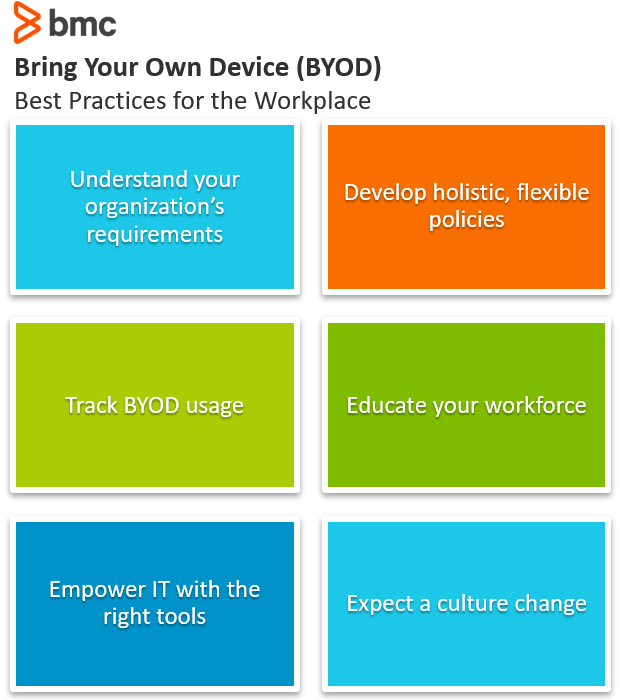
To address these challenges, organizations must invest in the right skillset and advancement in IT transformation to align service management capabilities with the BYOD needs of fast-paced DevOps-driven processes.
From a strategic perspective, the following policy best practices can empower organizations to achieve these goals:
Every organization differs in structure, culture, diversity, workforce preferences, IT policies, and regulatory compliance requirements. These differences are exacerbated due to your company’s:
As a result, every organization may have unique limitations on BYOD technology adoption, preferences, and requirements.
In DevOps environments, the organization must empower the service management function to develop protocols and procedures designed to facilitate their own unique BYOD requirements in the context of the challenges they face. This approach will ensure smooth BYOD adoption that leads to workforce productivity—without disrupting the behavior, compliance, and security posture of the organization.
It is practically impossible to satisfy every member of the workforce with BYOD policies. Regardless of the device, BYOD policies should encompass different user roles, privileges, and controls as part of your mobility strategy.
The most engaging enterprise mobility strategies that facilitate effective collaboration, information access, and strict adherence to security best practices do take a flexible, user-centric approach:
BYOD employee-owned devices are common targets for adversaries, especially in the age of AI cyberattacks. Vulnerable personal devices with high-level user access and privileges can cause costly data leaks and potentially irreversible damage to the business.
With the enforcement of stringent data regulations like GDPR, organizations must balance workforce demands for BYOD against regulatory compliance and security threats. The security risk and implications of BYOD adoption have emerged as a top concern among business organizations, according to Verizon.
Managing corporate data through intelligent mobile device management is key to appeasing your employees who want to use their personal devices—without allowing said devices become an easy route for sensitive data leaks. Real-time security monitoring and detection become critical to ensure secure enterprise mobility practices with BYOD. IT needs to:
End users act as the first line of defense against cyber-attacks or the first loophole in BYOD security. Knowledgeable and security-aware professionals can help ward off a majority of cyber-attacks that initiate when downloading malicious apps, accessing rogue websites, or clicking links in phishing attempts.
Train and convince your workforce to comply with your organization’s security and BYOD policy in a few ways:
When devices may become the agents of your downfall, the last point is especially important. If you are going to trust your employees to bring their own tablets, laptops, and phones to work with, you need to trust your employees generally too. The technology is a risk, but so are the people you trust to use them!
Forward-thinking business organizations transform their IT to meet the mobile device and BYOD needs of today and tomorrow. Organizations need to understand their current working environment and clarify the desired future state of enterprise mobility.
BYOD policies should be designed to engage internal customers with the right processes, data, and technologies to transition between the current and desired future states.
Employ capabilities such as automated device enrollment and configuration and real-time troubleshooting to reduce service desk interactions.
(Read more about enterprise mobility management.)
Finally, an effective BYOD policy should be designed to instigate a cultural shift toward secure and productive enterprise mobility practices. DevOps already brings best practices that facilitate strong interdepartmental collaboration, integrated business and IT operations, and automated workflows that streamline the adoption of new apps, technologies, and processes.
Design your BYOD policies to identify and eliminate the inhibitors to BYOD success, such as:
Mobile devices are everywhere, and they bring the amazing potential to do something great. Personal devices not only improve employee output and happiness, but they bring cost savings too.
For companies that want to enable employees to use their own mobile devices to connect to the work network, think about your security posture and failsafes. Although you have the technology to implement the policy, could your organization suffer data loss through lost or stolen devices? Do you have enough security responders to put out the fire if something compromises a laptop that isn't secure?
If you're working in an agile environment, employees often expect to bring their own devices. Think about the benefits that your employees will bring, but not before you sort out your security posture, MDM, and other issues that could be stoked by an employee using a personal device for work.